Showing posts with label Working Life. Show all posts

Sunday, October 28, 2007

Work and Travel USA’07 (Working at Nathan's)

One fine morning, a week after I started working at the gift shop, I received a phone call from our manager, telling me that I'll be transfered to Nathan's (which is right next door to the gift shop). I freaked out. For me, that was not a good news by then because working in the gift shop is so relaxing and there's not risk of burning yourself. However, it was the manager's order. As an associate, I have no choice but to follow.

My new working place.

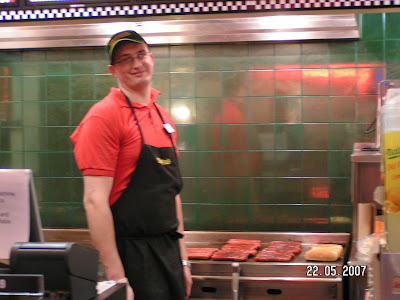
So, I have to start all over again, learning about the chores at a fast food outlet. Looking on the bright side, I get to learn new things.....again. First, I was put to the grill (not on the grill, but in charge of grilling the food), which is quite fun but you'll get hot and sweaty. On the grill, we make food like hotdogs, philly cheese steak, and chicken pitas.
Me, on the grill,just like Spongebob at Krusty Krab.

Peter, also put on the grill on his first day at work.


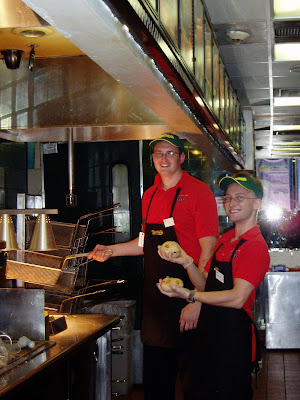
Next, learn how to make fries.


Peter and Marcin, playing with potatoes.


Although Nathan's Famous is famous for hotdogs, we also have other food like chicken and fish sandwiches, philly cheese steaks, chicken pita, hot dog nuggets, corn dogs and chicken wings on the menu.

We have a variety of sauces (ketchup, mustard, honey mustard, BBQ and sweet & sour), cheese, sauteed onions, sauerkraut and chili to go with the food. Well, the chili here is not the normal chili we Asians have. It is something made of minced burger meat, pepper and beans, and the Americans call it "chili". For me, it taste horribly sour and not spicy at all. I wonder, since there's absolutely no chilies in it, why did the Americans still call it the chili? Weird.


On the top is where we put our hotdog nuggets, corndog and chicken wings. At the bottom, we have lettuce and tomatoes, grilled chicken, buns and all sorts of sauces.


We also make coffee.

And that's only the front part of the concept. At the back, we have our kitchen.

Microwave oven to heat up frozen food.
We crinkle cut our fries from fresh potatoes daily.


After cleaning up everything by the end of the day, it's time to knock off.


On top of making food, my main role at Nathan's is also a cashier. For the following weeks, I work in both concepts (Gift Shop and Nathan's), which is good for me as I get more working hours.

Working at Nathan's isn't as bad as I expected. It is true that we burn ourselves sometimes, and it's busy as hell here at Nathan's during weekends and holidays. Even so, there are more people (young people) working here than the gift shop. This means making more friends and more people to talk to when business is slow. And the best part is...FREE FOOD. Ooooopppzz~

Saturday, October 27, 2007

Work and Travel USA’07 (My Job at the Gift Shop)

On the first day of my work, I was assigned to the Gift Shop. Apparently, they need MAN-power to deal with the stockings. So, I started with simple tasks like getting stocks from the stock room and fill them up at the shop (physical) and memorizing all the prices of items we have in the shop (mental). Well, items in the shop includes:
T-shirts, books and souvenirs.
Snacks.
And beverages.

Not only those, we also have films, disposable cameras, medicines and sundries. Some items like tobacco products, souvenirs, and sodas come with tax, while others like sundries and sugar-free snacks are non-tax. And I have to remember this too. After memorizing all these. My supervisor lets me have a go on the cashier, and that's when I really learn some new things.

As a start of the day, a cashier has to (of course) get money to put into the drawer. However, one must always remember to count the money upon receiving then from the cash room. Otherwise, he or she will be accountable for any shortage.

So, each cahsier will be givien USD300 to start a drawer.

  • USD70 in tens,
  • another USD70 in fives,
  • US100 in singles,
  • USD40 in quarters (25 cents),
  • USD20 in dimes (10cents),
  • USD10 in nickels (5 cents),
  • and the rest in pennies (1 cent).

So, you've put in your money. The next thing to do is to make sure you press the category button each time you ring up an item. And for those who has never been a cashier before, what does it mean by "ring"? Well, it simply means to register the cash that you've collected upon each sale. If you rang the sale with a wrong amount or wrong item code (over-ring), you'l have to get a authorized personal to do a re-ring for you. Over-rings are nothing unusual or serious offences. Supervisors normally expects up to 20 over-rings from a freshy cashier like me. However, as times goes by, my number of over-rings per shift decreases, and sometimes, none at all. I was also trained on how to make transactions using credit cards.

As cashiers, we are also provide with some guide-lines on how to provide good service. For example;

  • Eye contact with the customer,
  • Speak in a polite manner,
  • Up-selling (suggesting to the customer if he/she would like to purchase any other items)
  • Put purchased items into a shopping bag of suitable size, if only 1 item is purchased ask if customer would like a bag.
  • Always remember to give customers their receipt.
  • And finally, end the transaction with a nice gesture or wishing phrase.

Apart from that, we are also given a few tips on safety and security.

  • At all times, never put more than 5 USD20 bills in your cashier. If you do, drop them into the safe box.
  • If received a credit card which has been reported stolen, how to deal with the situation.
  • When being rob, it's always safety first, just remember how the robber looks like, and give him whatever he wants.

Well, that's a whole lot of things a cashier has to remember. But after awhile, I've got used to it and they've became a habit for me. For once every 2 weeks, we'll have a "inventory day", where we count every item we have in the shop.

Here's me, counting postcards on one of our "inventory days".

Tuesday, October 9, 2007

Event Job - Celcom XPAX™ ambassador

It was from the 18th till the 21st of December 2006, during the semester break, when I got a chance to work as a Celcom XPAX™ ambassador. What is a Celcom XPAX™ ambassador?

Towards the end of year 2006, the dateline set by the Malaysian government for every prepaid mobile number user to get their mobile phone number registered was approaching. And if they don’t, their number will be terminated. So, like any other Telco,
CELCOM® too has launched its own strategies to avoid its users from being terminated. And as a XPAX™ ambassador, our job is to assist those unregistered Celcom XPAX™ users to register their numbers.

The company really takes measures to make our job easy. Each of us were equiped with:

1. A T-shirt

With the bright colour, obviously its function is to make people notice u( as Celcom XPAX™ ambassador).

2. A Bag


Yeap, the elementary function of this thing is for us to put in our stuffs (personal or work related).

3. A Tag To make us look more professional, and to avoid us for being mistaken as conman.

And finally...

4. The XPAX - AXIA PDA Phone A108(The world's smallest PDA phone on Microsoft Windows)
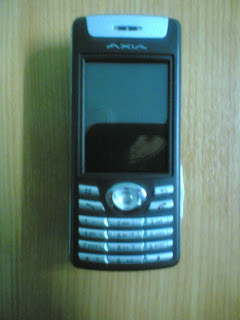
To enable us to register anyone on the spot.

Now let me explain to you how this gadget works;


First, you have to pull out the stylus…..(duh) Then, you tab on the screen, and this will switch on the phone from stand-by mode.

Notice that there is a card slot at the side of the phone.

Insert the IC of the user into the slot, and the all the information of the user (Full name, Address, Race, Nationality) will be automatically keyed-in in the PDA. Next, just key-in his/her number and the user will be instantly registered on the spot via GPRS.

Very canggih rite?

However, if the user doesn’t have an IC, eg. Army & Police officers, foreign workers, or they just simply don’t trust you enough to show you their IC, you can just turn to the alternative method;

Ask them to fill up this form.


The technical part of the job wasn’t that hard, it was approaching people that’s difficult.
Most of the time we were stationed at public places (bus stations, restaurants,..etc) and we need to approach strangers.
Here are some responds we get from the people upon approaching them with the question “Have you registered your prepaid number?(Sudahkah anda mendaftarkan nombor prepaid anda?”;
From the kind ones we’ll get,

· Sudah..Terima Kasih.
· (Smile at us and walked away).

From the not-so-kind ones,
· Sudah!Sudah!
· Tak ada telephone la…
· Gua ini Maxis/Digi punya la…
· Wa Bo Eng…..(I’m not free in Hokkien)
· (Totally ignores us).
· Eh,…..is this for real?...are you a conman? Why you wanna cheat people?
· Dun wan! Dun wan! (even before we said anything).
· I registered already la….why keep asking me~!
· Why I registered already my number still kena block?

Obviously, people (even myself sometimes) tend to take us as salesmen whenever we approached them this way. However, if we’re lucky enough to be stationed at Mobile Telephone shops, or CELCOM® booths, then people will come to us by themselves.

And so for 4 days, here and there we went. It was quite a lot that I learnt and made new friends as well. Not to mention, some extra pocket money~Hehe~

(P/S: Btw, I'm a Maxis User).

Monday, October 8, 2007

Life of a Construction Worker (Part 5: Time to leave)

Over the days, we completed 3 houses. It was time when the boss (my uncle) declares a break for everyone. It was a break for everyone, but it was the end for me. There are still a lot that I can learn but it is almost time for a new semester.

Through the days, I just can’t help realizing how some people tend to look down upon people like us (the construction workers). Here’s a few response I get when people know that I work as a construction worker.
  • Most children will say: Yerrrrrr~!! (I don’t need to explain this do I?)
  • For those who met you for the very first time: Li si buey thak chek liao shi bo? (You are not good in your studies izzit?)
  • For some of the people I know: Why are you doing this?

Some seem to label us as boors, illiterate and useless members of the society. Is it such a humiliation working as a construction worker? But hey, there won’t be an occupation if there’s no need for it. Without construction workers, we will have to live back in the caves or jungles. They have an important role in “building” up civilization. But of course, they are still many that are aware of the fact that every occupations has it role.


Working under the hot son has surely taken its toll on my integument system. My complexion got worse and my arms and face got really tanned. But constantly lifting heavy stuffs has indeed built a few muscles for me and toned up my body a little bit. Mentally, I learned to endure hardships and became thriftier (knowing that money is hard to come by). Yes, it is hard, not anyone can endure all these, but I’m proud that I had, at least for a few weeks.

Life of a Construction Worker (Part 4: Much More to Be Learned)

Just I expected, I woke up the next morning aching all over. A mental war took place in my head as I’m struggling on whether I should go to work. I didn’t take me too long before I made the decision. My reason? Taking one day off will not help much in recuperating my strength. Plus, I’ll never adapt to the job if I always rest when I feel aching over. Strangely, after the third day, I don’t feel aching over anymore.
Throughout the subsequent days I find myself steadily adapting to the environment. From only being able to push a halfly-filled-cart, I can now push 3-quarter of load without any problems. Soon, I was let to do chores that are more technical, that not only rely on brutish strength. For starters, I was asked to saw woods and break walls with hammer and chisel.
Hammer and Chisel. Yeah~ I accidentally hit my fingers a few times.


Then again, everything seems easier than doing it. After the demolition and removal of the concrete floor, the soil beneath needs to be leveled for the replacement of new concrete. It was then; I learnt some simple methods of leveling soil. To make sure that the ground is really flat, sticks and thread. It is easy not to explain the whole procedure in words, anyway, here is a picture showing one of the steps of this method.


As the renovation progress, I find myself seeing many things for the very first time.

First, I was introduced to a gadget that is used to make a straight line on wall. You see, it is very hard, or should I say almost impossible to draw a straight line on a concrete wall, so this gadget is used;

First, the ink-soaked thread is pulled out, and pressed onto the wall on its two ends. Then, the center of the thread is pulled and released. The elasticity of the thread made it snap on t the wall when it is released. Hence, the ink on it stained the wall. Understand? Smart and simple isn’t it?


There are many heavy machines used at a construction site. After testing out the jack hammer, I came across another “jack”, - the Jumping Jack Tamper. It’s an excavate equipment used to make to soil flat and more solid by stomping on the soil. Once again, I was allowed to give it a try. The thing is so heavy, that the strength of 3 men is required to move it. It is powered by petrol. Once started, the equipment vibrates like mad that it almost shook my flesh off from my bones when I hold it for just about 5 minute. The engine is hot, and the smell of petrol combustion is just killing me. I really take my hat off for those uncles for making such a difficult task looked so simple.

The Jumping Jack Tapper.

The Jumping Jack Tapper in action.
Before a new layer of concrete is poured on, iron net is laid on the ground for better adhesiveness.


After the concrete floor had been demolished and the soil had been thoroughly leveled, it is time to pour in a new layer of concrete to replace the old one. On the sixth day of my life as a construction worker, I arrived at my work place with a surprise waiting for me. A huge concrete transport truck parked right in front of the house that we were working on. The veteran workers are already there, building a new concrete floor at the porch of the house.

Concrete transport truck. A truck load of concrete cost about RM700 to RM800.

Moulding the concrete.


Soft and wet concrete.
After 5 to 6 hours, the concrete will solidify.


Sometimes the weather will be kind to us. Occasionally it rains, and if the rain is too heavy, we have to stop working. Upon the finishing of the whole renovation process, we have to work over time.

Life of a Construction Worker (Part 3: The Real Game Starts)

It was the following morning; I woke feeling muscle pains in my back and thighs. I could see some mild skin irritation on my arms as well. Confident that my body can still take the challenge of construction work, I made my way to the site on time. Just like the day before, the working duration can be divided into four time slots. The first slot is 8 to 10am. Well, this is the most relaxing part of the day, with the freshness of morning air and ends with breakfast brought by the boss at 10am. The next slot is still bearable; everyone still has enough energy to counter the effect of temperature rise.12pm, the time which everyone labourer will be waiting for – lunch break. Most of them will only take a short time to eat and spend the rest of the 1 hour having some casual chats. The third time slot is the most agonizing. It was as though time as crawling for the hottest 2 hours of the day before the slot ended with a tea break at 3pm. The things turn better at the final slot when the temperature slowly reduced and the arrival of knock-off time at 5pm.

My day at work starts with clearing rumbles using a one-wheeled cart. Back and forth I went from the site to the dumping grounds. I picked up the rumbles by hand, each of them felt like a durian. Uncle Hu, who was demolishing the concrete floor, let me had a chance to try out the gigantic jack hammer. Again, it is much heavier than it seems.

Uncle Hu, with a Jack Hammer. Compared to the mass destruction he made with the pneumatic machine....


This is the miserable small hole that I made using the same thing.

However, I only manage to make a tiny hole on the floor. Everything went fine until the sun starts glaring fiercely at us.
Under the hot sun, I discovered that labourers have their very own way to reduce stress from the heat. Here are the Top 5 shouting phrases (all in hokkien) you can hear at a construction site when the sun is boiling everyone:

  1. JUAK AR! ( hot ar)
  2. SIBEH JUAK! (very hot )
  3. PAI MIAAAAAA!! ( hard life)
  4. BO HO THAN AR!! (not easy to earn ar)
    And when the sun is really pissing them off
  5. LIN LAU HIAH EH!!! AN ZHUA ANI JUAK EH???!!!! (Your elder brother, why is it so hot?)

It was so funny that it kind of made me forget about the hot sun for a while. But little did I know that a harsh day awaits me?
As time goes by, my energy depletes faster. The rumbles seem to grow heavier. Soon, I take short breaks more frequently, but can only make less rounds of rumble disposal. I was wearing out. After making some rounds, I checked the time. WHAT?? Only half-an-hour has passed? But that felt like it has been an hour or so. Time passed really slowly. My body was burning. That’s I took the advice of the senior workers: “Ban ban lai, buey haio kin eh.” Working fast only drains me rapidly, and recuperating my energy will take a longer time. If I rest too long, it’ll appear as though I’m skiving. Work slowly and I only need short breaks. That’s when I learn to take things slow but steadily.
5 o’clock finally came. Oh my, am I the happiest person in the world? I reached with a whole body of aching muscle. My determination and perseverance is still there, but my flesh is really worn out. I’m not sure if my body will be in a good enough condition to work for the next day.


Life of a Construction Worker (Part 2: The Very First Day)

My first day at work was on the 1st of June. I reached the site at around 8am. Yes. Everything one can expect at a construction site was there: tools, bricks, dirt, heat, rumble, body odour, vulgar words, and etc. As a zero in constructions, the first task that I get is to transfer bricks by using a one-wheeled cart. Hmmm….simple isn’t it? That’s what I thought, until I finally get my hands on it. Damn it! 25++ bricks can actually be so heavy? And the cart was so hard to control. But the veteran workers made it looked so easy. And so, I was advised to take only 15 bricks for each go.

Well, I tried to make myself useful, just before I realized that I know nothing about constructions. So all I can do then was to push the cart, sweep the tiled floors and bucketing mixed cement. Yes, bucketing cement: shovel mixed cement into a bucket. Simple? Yeah~ that’s what I thought, until I finally get my hands on it. Guess how much a fully loaded bucket (which can filled up to 3 shovels of cement) weights? It was much heavier than I expected. Almost 30kgs according to my rough estimation. That’s when I conclude Rule No.1 in construction works: Everything is heavier than it seems.

Nevertheless, I grab every chance to learn. Anyone here knows how to mix regular Portland cement? The materials needed? The correct portion? Well, my observation had given me the answer. To get a cement mixture, the materials needed are: cement, sand, brown soil and water. Every 25kg of cement needs to be mixed with one-and-a-half cart-full of sand, a cart-full brown soil and about five to six buckets of water. The mixture will dried up as time goes by, this will then increase the viscosity of the mixture, causing it to be harder to be applied on to the walls. To over come this, water has to be added to the mixture if it’s to dry or viscous to use.

It was quite a tough day for a beginner like me. The environment is very messy, things are heavy and everyone stinks. But the funny thing is Rule No.2 in construction works: Everyone is smelly, everything is dirty, but nobody gives a damn about it. The most important thing is to get the house done in time. So everyone is too busy to care about the odour and the mess. It wasn’t so bad after all, as the other workers always keep a cheerful atmosphere, chatting about almost anything under the sun. From dirty jokes to politics, big or small, they talk about it. Everyone play their part, and cooperates. The progress of renovation runs smoothly, the boss is happy and bought tea for everyone.

The day soon came to an end at around 5pm. Although the tools are hopelessly dirty, cleaning still essential as to prolong their functioning life. After cleaning and keeping everything, it was time to knock off. It was so much and yet so little that I’ve experienced.

Yes, this is a common one-wheeled cart, which has been my “assistant” during my days at the construction site. Less than RM100 each.

Life of a Construction Worker (Part 1: How I Got In)

Yes,……..It was the long semester break during the month of May and June. Yes,…..the break was so long, and everyone has their own way of spending the break. Some will be quite occupied with part-time jobs. Those who are fortunate enough will be having fun traveling and visiting interesting places. Others might be having a hard time passing time and dealing with boredom.
As for me, after “resting” at home for two weeks, I get a chance to expose myself to the “softer-side” of construction works- renovation. Softer-side? Yes. Compared to the actual construction works (which is building something out of plain ground), renovation works are less straining, and you don’t have to climb too high. The basic building structure is already there, all we need to do is to add or remove structures according to the liking of the owner of the house. And most importantly, refine and beautify the basic structure so that it is cosy enough for people to stay in it.

It begins from a visit to my uncle’s house. He is a renovation contractor – specialized in cement works. For other parts of the whole renovation such as, wiring, piping, painting, tiling and etc, he sub-contracts to other contractors. The idea of “Hanjin – working as a construction worker” came suddenly between the conversation between my Dad and uncle, when Dad feels that such exposure is beneficial to me as I have nothing much to do at home during the long break.

And so, after some encouragements from Dad, and mental struggles, I finally decided to take up the challenge. Me, Hanjin, a small and skinny guy. How long can I last as a construction worker? Well, we’ll see about that.

Sunday, December 31, 2006

4C's of Diamond

Determining Diamond Quality
Diamond quality is evaluated by four characteristics, called the "4 C's": carat weight, clarity, color and cut. Though many people like to debate the value of each characteristic, most good jewelers agree that a balance of all four characteristics make a good quality diamond.

Carat Weight: In 1913, a standard for measuring the weight of diamonds and gemstones was created. The standard weight, known as a carat, was the same title giving to pre-standardization measurements and actually derives from the word for carob seed, which was the unit of measurement by which gemstones were weighed in ancient times.
One carat is equal to 1/5 of a gram or approximately .007 oz. One carat is then divided into smaller units of measure, called points, each carat equaling 100 points. Diamonds less than one carat, or measuring in-between carats (i.e. one and one half carats) are generally measured by points and are rounded off to the nearest measurement. For example a 3/4 carat diamond is a diamond measuring from .69 points to .82 points, and is still considered a 3/4 carat diamond.
Carat weight plays a very important part in the value of a diamond, though diamonds of the same weight can vary greatly in value depending on the quality of the other "C's".


Clarity: The clarity of a diamond is a measurement of the inclusions or blemishes inside and/or on the outside of a diamond, under a 10x microscope. The rating system is subjective to the master diamond cutter, though the guidelines are as follows:
FFlawless
No internal or external flaws can be seen under a 10x microscope when viewed by an experienced diamond grader
IFInternally Flawless
No internal flaws may be seen under a 10x microscope by an experienced grader, though there may be a few minor external blemishes
VVS1, VVS2Very Very Slight Inclusions
The diamond will contain inclusions but they will be difficult to see for an even experienced grader under a 10x microscope
SI1, SI2Slight Inclusions
Diamond will contain inclusions easy to spot under a 10x microscope and may be visible to the naked eye
I1, I2, I3Included
Inclusions are visible to the naked eye
A completely flawless diamond is very rare and the price would reflect such. Diamond quality is effected by its clarity, therefore a the higher the clarity, the better the diamond.

Color: Though most people believe that diamonds are colorless, diamonds, in fact, come in every color of the rainbow. The colored diamonds, known as fancy diamonds, are even more valuable than traditional white diamonds and can be red, pink, blue, green, orange, and brilliant yellow (not to be confused with slightly yellow, which is considered to be a poor quality white diamond).
Fancy diamonds aside, white diamonds are graded on a chart and colorless diamonds are considered the highest quality. The quality ranges from colorless (letters D, E and F), to almost colorless/brown/gray (letters G, H, I and J), to faint yellow (letters K, L and M) all the way to the letter Z, which signifies a light yellow diamond. Because colorless diamonds are considered the most prized, diamond quality in the higher letters (D, E, F) are the better choice.

Cut: The fourth "C", cut, is the only "C" on which humans have any control. For the other three "C's", carat weight, clarity and color, mother nature deals her hand and we get what she gives us. Cut can play an important role in diamond quality, because a poorly cut diamond can ruin the value of a stone, and in today's world where profit is the name of the game, master diamond cutters with years of experience are in charge of diamond cutting for any reputable company.Cut refers to the geometric shape and proportions to which a diamond is pared. In the 1930's a Russian mathematician named Marcel Tolkowsky, derived a formula for which the calculations of the proportions of a diamond's facets (in a round diamond) that would bring an ideal balance between brilliance and dispersion. Since then, his formula is the calculation by which all diamonds are measured. Though the exact calculation and geometric design are much too complicated to explain, it is important to know that a round cut diamond has 57 or 58 facets (flat planes or surfaces on a diamond that must be cut in exact relation to the others to create the most fire and brilliance). Each facet must be cut an polished to the exact specifications in relation to the other facets on the stone. If facets do not match exactly, the stone it cut poorly the diamond quality decreases.

Source:http://wizard-of-jewelry.com/diamond_quality.asp
Other related sites:http://damincci.com/4c.htm
:http://spartanspirit.com/diamonds/4cs/

My Days In Jewellery Business (Part 5 : Time to Quit)

It has been almost 3 months since I started working at Diamondlink. I was exhausted. Both mentally and physically. It was on the 31th of March, that I decided to tell my boss about my resignation. I told him that 7th of April will be my last day. He asked me to stay....but my mind is set. I've learn enough, earn enough and enjoyed enough of the job. But most importantly, I've had enough. It's time for me to take a break.On my last day, my follow colleagues really touched me. They gave me a clock that I've always wanted( I hint them from time to time...hehe), asked me to "belanja makan steamboat" and told me to visit them whenever I'm free. We couldn't make it on the day itself, but I promised them that I'll belanja them some other day. It was quite a memorable day. The funny thing is I realised that I can't bear to leave the shop. However, this is not the end of my affiliation with Diamondlink. For some reason,I still drop by almost everyday even though I'm no longer an employee there,kekeke...Until the end of May, that's when my affiliation with Diamondlink really ended.

P/S: The picture on the left does not have anything to do with me or this post. It is purely for humour.

My Days In Jewellery Business (Part 4: Things are not looking good)


After the nice short and sweet month of February, life went on as usual. Life was a routine. I woke up everyday at 9.00am, reach my work place at 10.45am on week days, 10.30 on weekends. Clean-up, arranged jewelleries, waited for lunch time, served customers occasionally, waited for dinner time, get exhausted, and finally, it'll be time to go home. My off-day will be the most anticipated day of the week. Where I can have a little me-time, resting and relaxing. I hardly have time of my own. No time to exercise, not much time to catch up with friends via the Internet like I always do, no time to go to church and most importantly, not enough time to sleep. But good enough for me, many of my friends will drop by when they pass-by the little jewellery shop and made time pass a Little bit faster.
Slowly, the long hours of working hour has taken it's toil on me. Not only physically but emotionally as well. Physically, I began to get tired easily, losing concentration, and feeling my muscles becoming more and more flaccid. And the improper diet I had everyday made me felt malnourished. Emotionally, the bickering's among colleagues over commissions, inter-personally conflicts and poor working attitude of certain colleagues were driving me up the wall. The pressure our boss put on us due to back-slacking business had also pissed me off. Through the month, situation worsen. I'm tired, really tired. I don't know how long I can still hang on. I began to think, is it worth for me to go on like this over the basic salary of RM800?
However, there's still something worth-while on top of all the unpleasant issues. I made a few good friends and eventually grown to be closer with them. Seeing my customers satisfied with my service was another thing that kept me going. Even though it was tiring and boring staying in a small shop with heat-emitting spot lights which made us feel dizzy, we still had some happy moments together, joking and have some heart to heart talk. So, I decided to stay a little longer.

My Days In Jewellery Business (Part 3: February, the best month of all)


February is not only the shortest month, but also the month with most events. This year, we have Chinese New Year and Valentines Day in our February. Sure enough it is a month where business will be picking up. As for an employee like me, I enjoyed what every worker is waiting for, ang pow (bonus) from our taukeh. Not only that, as sales were going on well, our commission increased as well. I finally understood why every businessman will be so happy when CNY is around the corner...everyone will be in a spending frenzy. However, the continuous pouring in of customers means we'll have to work like bees. For the whole week before CNY, we rarely had time for lunch or dinner breaks, we ate take-aways for one whole week. Fortunately, our boss was kind enough to sponsor our meals. February is sure the month with the most income and the least spending. Everyone was happy. Sadly, it didn't last for long,.....just 28 days.

My Days In Jewellery Business (Part 2: Back In BP)

(*The shop shown here in the picture no longer exist,...get what I mean?)


2 weeks of hell in Kl finally passed, soon we were back in BP where the air smells familiar. After having nice long sleep for the first time in 2 weeks, it's time to work ......again~. It started with a major clean-up project. (New shop ma....must wash clean clean lo). Followed by a long and tiring day arranging our precious jewels. It was as tiring and exhausting like our days in KL, as we are rushing to open for business before Chinese New Year. Luckily our boss knows how to appreciate and motivate us to work for him....kept belanja-ing us. (smart fella). Before we know it....it is time to "kui thua" (buka gerai), and do business. This is where things are really getting started.....

My Days In Jewellery Business (Part 1: Working in KL)

Ehem, now let's talk about a thing or two that I experienced during my time as a amateur jeweller( It was just after my STPM). Keke. Well just in case anyone of you doesn't know, I've worked in a jewellery shop for 3 months. I'm just lucky enough to bump into this job, as it was purely by accident. One of my friends, accidentally sent a sms to me, asking me if i would like to take this job. (the sms is actually for somebody else). Oh well, after barely passed the interview ( with my long, untidy and highlighted hair) I've got the job. The first 2 weeks of the job was hell for me. We were sent to Petaling Jaya for training. Over there, we worked and learned. Imagine having to wake up at 8am, and sleep at 2am everyday. I was exhausted. Anyway, it was a worth while experience. Through this job, I was forced to learn how to wash and iron my own clothes. *feeling quite ashamed of myself*. Actually, my job over there is rather simple. All I have to do is stand all day, and run some additional errands requested by the arrogant and ugly looking manager. I don't have a chance to really talk business with customers as I don't know how to speak Cantonese. It's kind of bored actually. I would say that it's mentally easy but physically straining. I manage to make a few friends there. I receive my first fruit of labour (wages) there too. I just can't hide my joy when I saw my pay slip. Just when I was beginning to like it there, it is time for me and another 3 colleague to return to BP, for the opening of the company's branch here.